October 23, 2009Contrarian
Although I’m not one to whine about “media bias” — newspapers and other media being private enterprises entitled by the First Amendment to express the “bias” of their choice — it is dismaying when they do so by distorting, omitting, or manufacturing the underlying facts of the story, or by allowing a source or informant to do so. When they do so deliberately, it reveals a lack of professional integrity. When they do so by inadvertence, it reveals a lack of professional competence.
In other words, slant the story any way you please, but do try to get the facts right.
I suspect inadvertence, or perhaps just editorial laziness — was responsible for the Spokesman-Review’s October 21 story entitled, “Report says cost of living higher in state’s poor neighborhoods.”
“Poor people may feel like they never get a break, but it’s worse than that, according to a study of low-income families in Washington. They are getting gouged,” wrote reporter Kevin Graman.
The story is laced with such phrases as “the findings,” “the state study . . . revealed price disparities,” “the report . . . details how the poor pay more for goods and services,” and so on — language intended to convey an impression that a rigorous scientific investigation had unearthed some damning new evidence of injustices which demand immediate remedies.
The “study” in question was, of course, nothing of the kind. It is, instead, a classic example of a pseudo-study, manufactured to create pseudo-news which advances its authors’ political agenda.
Read More »
Posted in political nonsense |
October 21, 2009Contrarian
Some greenie true believers in New Zealand have proposed a new method of reducing your “carbon footprint” — eat your dog.
And your cat, too.
They calculate that feeding your spaniel requires 0.84 hectares (about 2 acres) of land annually. By comparison, sufficient biofuel to build and drive your Land Cruiser 6200 miles could be produced on only 0.41 hectare. Your cat’s carbon footprint is about the same as a Volkswagen Golf’s.
“Professor Vale says the title of the book is meant to shock, but the couple, who do not have a cat or dog, believe the reintroduction of non-carnivorous pets into urban areas would help slow down global warming.”
Full story here.
Hmm. If I ate Grandma, could I maybe keep my Winnebago?
Read More »
Posted in Uncategorized |
October 10, 2009Contrarian
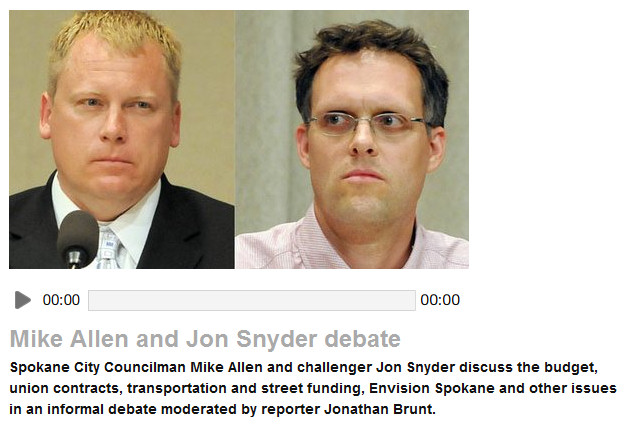
An interesting exchange here between Spokesman-Review reporter Jonathan Brunt and City Council candidate Jon Snyder regarding the “big box” development on the South Hill approved by the Council last year. Snyder had stated that he would not have approved the zoning change which will allow the development. (Exchange begins ~ 37 minutes).
——
Brunt: How do you judge when to keep a business out and when to allow a business in?
Snyder: I want to reframe that question . . . the question is, How do we plan or create development that is good for everyone . . .? There are some really great examples in other parts of the Northwest of creating an urban village that is walkable, bikeable, doesn’t involve the maximum amount of square footage, that integrates a mixed-use approach, that allows people to live near where they’re going to be walking to . . . that is the question — how do we create that up there? In order to do that is why we need leadership on the City Council. The City Council should not wait until a developer comes to them and says, “We want this . . . how do we change the Comprehensive Plan to get it?” The City needs to be out front, working with the neighborhoods and developers trying to come up with a planned solution that makes sense for everybody.
Brunt: Is there a place say, south of I-90, that would be OK for a Home Depot, or a Walmart?
Snyder: I don’t see any place that would be great for a Walmart. We have plenty of Walmarts in this town. We don’t need any more.
Brunt: What about a Target or a Home Depot?
Snyder: I’m not interested in advocating for any one of those particular national chains. I mean, people may have their favorites and what not, but what I look at is, I see a Manito Center and a South Perry district. Those places really need some support. You know, Manito went through this whole planning process a couple of years ago, which really didn’t go anywhere . . . That needs to be started up again . . . But unfortunately we have a situation where a lot of retail energy is going to be sucked away from Manito because of the Southgate development.
——
Well, that’s about as clear an example of what Hayek called the “Fatal Conceit” — not to mention bureaucratic arrogance — as you’re likely to find anywhere.
Read More »
Posted in Urban Development |
October 6, 2009Contrarian
Most of the considerable opposition which has emerged to date to Proposition 4, the so-called “Community Bill of Rights” which will appear on the November general election ballot, has focused on the measure’s fiscal implications for the City and its implications for the local economy. These are certainly serious concerns. Indeed, the measure is likely to have adverse impacts even if it fails, unless it is defeated overwhelmingly. A narrow defeat will still discourage investment (and encourage disinvestment) in the city of Spokane, because investors and entrepreneurs will worry that Prop 4’s leftist backers will soon try again. It will stigmatize Spokane as a risky place to do business.
But an even more compelling reason for rejecting it is the moral one.
This “Bill of Frights” (a “fright” being a fiat right) declares that persons have “rights” to “affordable” health care, housing, energy, to be paid a certain wage, and various other goodies on every leftist’s wish list. The trouble here, of course, is that all these goodies must be provided by other persons — health care workers, builders, energy producers, employers, et al. So a claim to a “right” to such things entails a claim to the services of other people — to their time, talents, energy, and the fruits of their labor.
Read More »
Posted in Political Theory |
September 24, 2009Contrarian
Some new additions to the Encyclopedia of Political Nonsense. After a few more I’ll give the Encyclopedia its own page.
Greed. The standard leftist term of disparagement for the drive, common to all living organisms, to thrive, i.e., to survive, increase its security, reduce its discomforts and risks, and provide for its offspring. For humans, thriving means securing as many of the things they value as possible. Leftists hold the term in contempt because they labor under one or both of two common fallacies, the Organic Fallacy or the Fallacy of Value.
Read More »
Posted in Political Theory |
August 24, 2009Contrarian
. . . on the Spokesman-Review’s “Matter of Opinion” blog, here. Yours truly is a participant, of course.
Read More »
Posted in Political Theory |
August 19, 2009Contrarian
Well, this being a political blog (although one which tries to focus on local issues), I suppose a post or two on the hot topic of the moment — health care — is de rigeur. And there is a local connection, after all, since access to “affordable preventive health care” is one of the fiat “rights” asserted in the “Community Bill of (F)rights” City Charter Amendment — that wish list of free lunches hoked up by the local Green/Left cabal — which will appear on the November ballot as Initiative 2009-2.
Perhaps because there is no Whole Foods outlet in Eastern Washington or Idaho, the local cabal seems to be ignoring the matter, but their comrades across the country are all in a snit these days over Whole Foods CEO John Mackey’s Aug. 11 Op/Ed in the Wall Street Journal in which he pointed out the obvious: that there is no “right” to government-provided health care, and that the problems with the health care system in the US are mostly of government making. He even had the lack of sense, considering his customer base, to quote Margaret Thatcher: “The trouble with socialism is that eventually you run out of other people’s money.”
Read More »
Posted in Democracy |
August 18, 2009Contrarian
FreeSpokane today adds a new feature — the Encyclopedia of Political Nonsense. It will be a compilation of words, phrases, and statements frequently encountered in social/political discussions which are either empirically false or rest upon assumptions which are empirically false. The qualifier “empirically” is important here: the Encyclopedia will not include statements with which I merely disagree or which assume values I don’t happen to share. It will not include statements around which there is genuine controversy and uncertainty (e.g., most of the debates concerning global warming). It will only qualify as “nonsense” if the statement or its underlying assumptions can readily be shown to be false by straightforward empirical methods — by observation, or as logically derived conclusions from observations.
Read More »
Posted in Political Theory |
August 14, 2009Contrarian
Gadfly attorney, intrepid blogger, former Spokane City Councilman and current Council Candidate (District 2) Steve Eugster today on his blog laments the decision of a South Hill neighborhood group to abandon their efforts to block a “big box” retail development on S. Regal St (S-R story here). Eugster calls the decision by the City Council last summer to allow the development “senseless,” and “contrary to good comprehensive planning.”
Steve must have held up his finger and determined that the political winds were blowing in that direction (the projects in question are located in his Council District 2). Though usually quite astute concerning the proper scope and role of city government, he is also a fairly astute politician.
Read More »
Posted in Urban Development |
August 13, 2009Contrarian
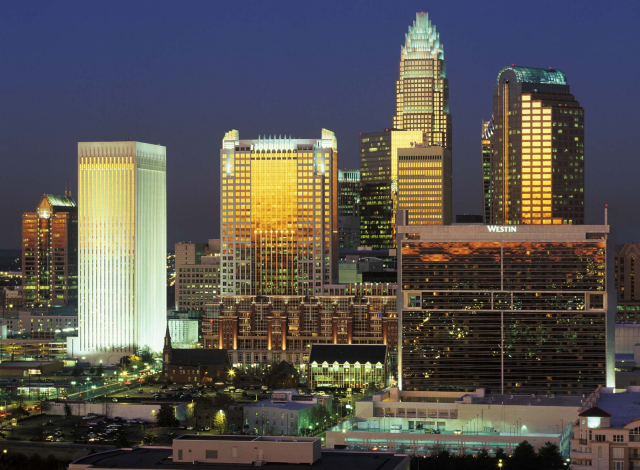
Charlotte, NC ♦ Photo © Team Alliance Global
During a recent conversation over coffee an acquaintance posed the question, “What does Spokane have going for it?”
My immediate and glib answer was, “Not much.”
No, I’m not a reluctantly relocated Seattleite, nor an exemplar of Spokane’s alleged inferiority complex. Spokane does have a number of significant assets, which Greater Spokane, Inc. and the Visitors Bureau regularly tout: affordable housing, minimal traffic congestion, decent schools, first-class medical services, outstanding outdoor recreational opportunities, and so on. The thrust of the question, though, was, “What does Spokane have to offer that other mid-sized Western cities don’t?”
Read More »
Posted in Urban Development |