Photo Galleries!
October 18, 2010Contrarian 1 Comment »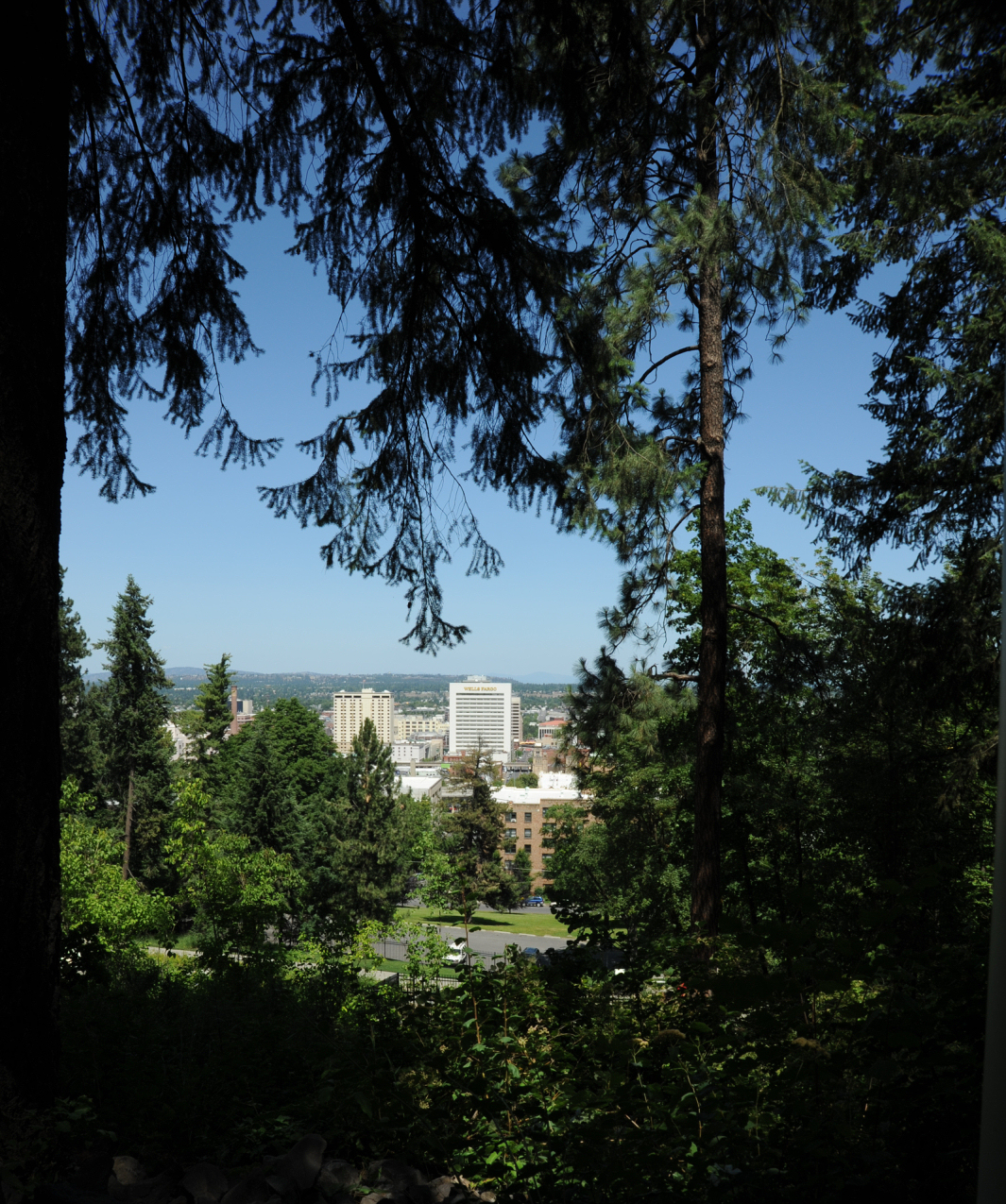
Peek-a-boo
The blog now features some photo galleries of Spokane area scenes. See sidebar at left. I’ll add shots and categories as the spirit moves me.


Peek-a-boo
The blog now features some photo galleries of Spokane area scenes. See sidebar at left. I’ll add shots and categories as the spirit moves me.
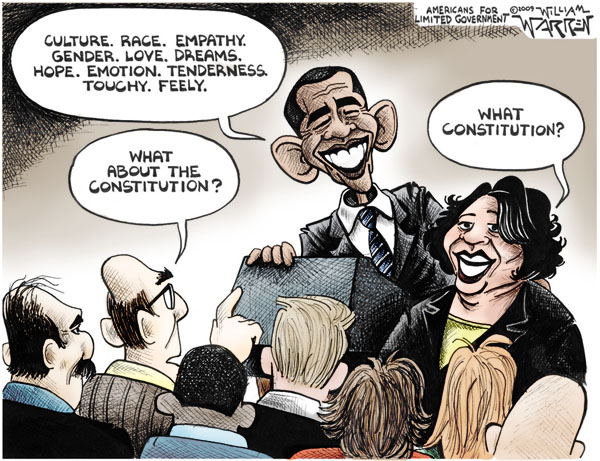
With midterm elections two weeks away and pollsters predicting that Republicans — many with Tea Party backing — will gain control of the House and perhaps pick up as many as 12 seats in the Senate, the challengers’ campaigns seem to be coalescing around two principal themes: substantially reducing the size of the federal government, and repealing Obamacare.
Democrats and their cheeleaders in the media have been loudly demanding that these GOP budget-cutters spell out in detail which federal programs they would dismantle should they be elected. They are betting, of course, that most of the insurgents’ Tea Party supporters are either syncophants parroting platitudes whose implications they don’t understand, or hypocrites who may be eager to snatch away someone else’s free lunch but will never willingly surrender their own. “Lay your program out on the table, TP panderers,” say the Dems, “and see how many votes it costs ya.”
Now, these calls might seem like nothing more than pleas for honesty and candor. And, to be sure, the GOP won a Congressional majority in 1994 by making many of the same the same promises, which soon proved to be hollow.
The Tea Party candidates would be well advised, however, not to dwell on the specific cuts they would make if elected. That would transform the elections into referenda on particular programs, when most of their supporters view this election as a broad referendum on the role of the federal government in the life of the Republic. Even Obamacare is merely a symptom of the problem, not its cause.
bicycle by HSB-Cartoon
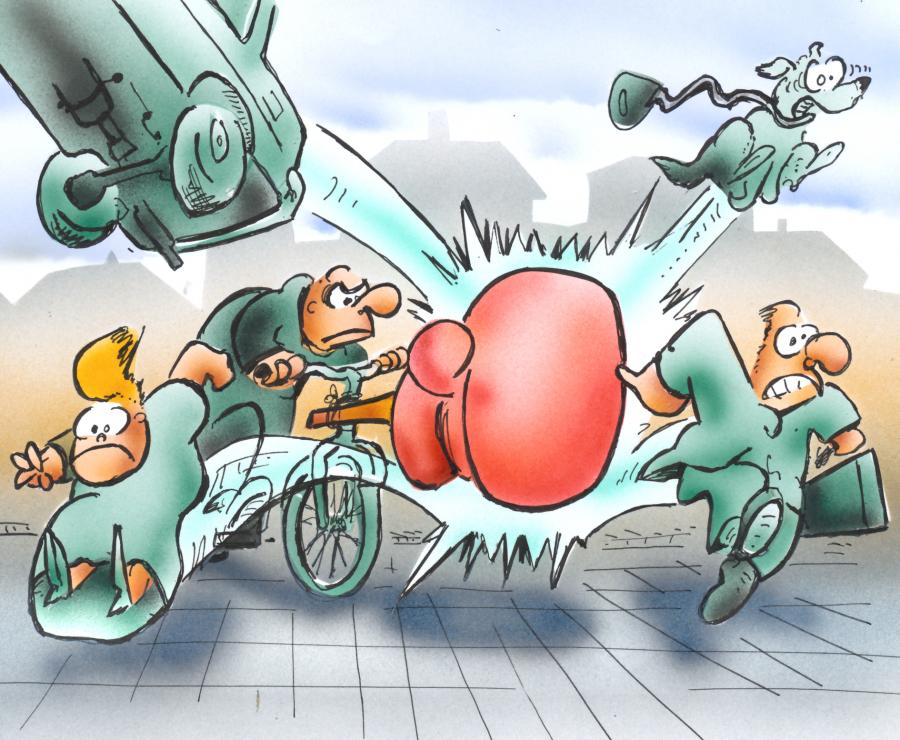
Well, the new “green”-tinged City Council has wasted no time in trotting out its first major boondoggle. Last Monday the Council voted 5-2 for a resolution directing city staff to attend a workshop to be conducted by an outfit called the “Complete Streets Coalition” — a Washington, DC-based lobbying group devoted to rebuilding America’s urban streets to conform to greenie notions of transportation propriety. The bureaucrats are also directed to find ways to integrate “complete streets” dogmas into City street planning. That means, of course, revamping streets to accommodate pedestrians, bicycles, and transit, and to discourage use of the hated automobile.
Scene from Night of the Living Dead
New entry in the Encyclopedia of Political Nonsense.
Social Justice. The Left’s preferred euphemism for material equality and its chief moral rationale for wealth redistribution.
As with many leftist neologisms, “social justice” attempts to appropriate a term with favorable connotations, such as “justice,” and use it to refer to something else, in the hope that unwitting audiences will transfer the favorable connotations of the co-opted term to the new referent. The new referent is always some tenet or goal of leftist ideology.
The new referent in this case is material equality. Leftists, being uniformly beguiled by the Organic Fallacy, assume without question that any differences in wealth, health, happiness, or other aspects of well-being to be found among individuals in a society are “unfair.” Then, following the late Harvard philosopher John Rawls, they equate “justice” with “fairness.” Hence inequalities of the types mentioned become “unjust.”
“Social justice,” then, in the leftist lexicon, is material equality among persons in a social setting.
Justice has, of course, nothing whatsoever to do with equality. Indeed, it presumes inequality. Justice, as commonly understood, consists in securing to each person what he or she is due. Per Merriam-Webster, “impartial adjustment of conflicting claims or the assignment of merited rewards or punishments.” In common shorthand, “justice” means, “getting what you deserve.” Justice is thus served when the innocent defendant is acquitted and released, and the guilty defendant convicted and punished, or when the student who turns in the best essay gets an “A” and the student who failed to complete the assignment, or plagiarized from someone else, gets an “F.”

image © msnbc.com
“You may not know it,” says MSNBC’s Brian Williams, “but you own some gold mines — actually, the public land where gold, silver, and uranium are dug out of the Earth.”
That sets the stage for a segment in the network’s “Fleecing of America” series, this one lamenting the 1872 Mining Law and the fact that it does not require miners to pay royalties to the government for the ores they extract.
http://www.msnbc.msn.com/id/3032619/ns/nightly_news#35883250
Well, in fact, you don’t “own” any gold mines. Nor do you “own” the land upon which those mines (like those in our own Silver Valley) are located. At least, not in the usual sense of the term. Nor does the US government — it has sovereignty over them, usually acquired by treaty, but does not, and never has, “owned” them. They were acquired, in fact, precisely in order to make them available to citizens willing to explore them, settle upon them, and make them productive. Most of them are, in fact, now owned by the mining companies which operate them, because the law allowed claims to be patented — transformed into deeds — once someone had made them productive. The Homestead Acts were based on the same premise.
Western lands were not acquired to provide free lunches for couch potatoes who had invested nothing in them — no money, no time, and no effort. But of course, that is exactly what the free lunch lobby, and the congresscritters who pander to them, are seeking — another windfall for their mooching constituents, at the expense of those who produce the wealth they hope to plunder.
“You may be wondering about now,” says Williams, “what you have to show for all this.”
Well, about as much as you have invested. Want some gold? Get off your duff and go prospecting.
 The Spokesman-Review reports that the “It takes a village” crowd is plotting a new local property tax to finance early childhood education programs:
“Volunteers will gather signatures starting Tuesday to put a levy before voters in August to establish a Children’s Investment Fund. The money would be used to support early childhood learning, abuse and neglect prevention and treatment programs, mentoring programs and before- and after-school activities.”
Collectivized child-rearing, a la Aldous Huxley’s Brave New World, has, of course, always been a priority goal of the Left. After all, one can’t properly program the kids for their assigned roles in Utopia if their upbringing is under the control of unreformed, individualistic, obstructionist parents, most of whom are political heathens.
To be sure, there will be a fair number of parents receptive to this plan. Anything to get those annoying rug rats out of their hair a couple years earlier. One does not turn down a free lunch.
“Four to six hours a day of free childcare? Heck yeah – sign me up. Thanks, taxpayers.”
But responsible voters will peruse the latest study of Head Start — the now-ubiquitous federal “early education” boondoggle created in the 60’s as part of Lyndon Johnson’s War on Poverty — before financing this new experiment in leftist social engineering.
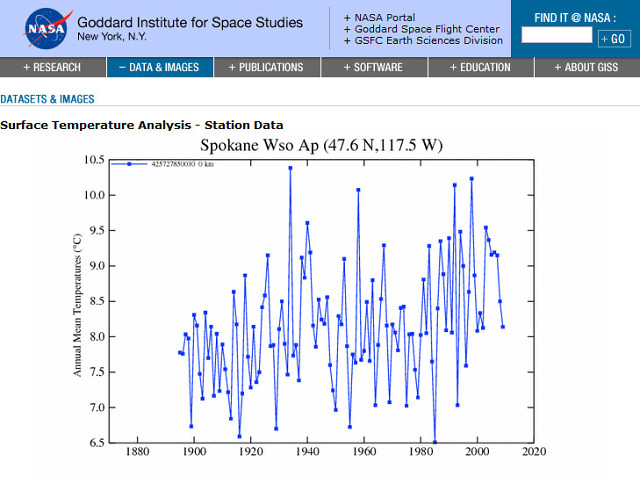
One series of emails from the “Climategate” CRU email release which has drawn some attention is this one between Phil Jones of CRU et al and Swedish climate researcher Wibjorn Karlen. It concerns the temperature trends in the Nordic countries shown in IPCC AR4. Karlen asks Jones and Trenberth for the data upon which the IPCC graph is based, since the data from the official NORDKLIM climate data network shows no such trend.
That discrepancy has prompted a flurry of mini-investigations by bloggers and their commenters around the world into similar discrepancies involving temperatures in their local areas — which they are finding all over the place.
Sometime yesterday a hacker, or possibly an inside whistle-blower, obtained access to the UK’s Hadley Climate Research Unit computers, downloaded over 1000 emails with attachments, bundled them into a ZIP file, and placed them on a public server in Russia. Links to the ZIP file were then posted on several AGW skeptics’ blogs. The purloined files have already been downloaded by thousands of snoops around the world.
The Hadley Center is one of the world’s foremost climate research centers (it produces the HADCRUT temperature database, used by all climate researchers) and is one of the loudest Chicken Littles of climate catastrophism.
While it will be days before the significance of these files can be established, they are certain to embarass, if not discredit, their authors — if they prove to be authentic, which has not yet been established. In some exchanges Hadley researchers discuss ways to prevent critics of AGW from being published; in others they appear to discuss methods of altering data to better fit their theories.
While not yet vetted, what has been published so far has the ring of authenticity. Moreover, the very volume of the material argues against a scam — few con artists would have the knowledge, time or patience to hoke up 135 MB of phony correspondence and papers.
An early look at the contents can be found here.
 In a debate on another blog (the Spokesman-Review’s “Matter of Opinion” blog), one commenter wrote,
“No amount of Libertarian Ayn Randian rhetoric about the long defeated concept of “enumerated powers” as why this country can’t have universal health care is going to convince any intelligent citizens.”
I asked how the doctrine of enumerated powers had been “defeated,” to which he responded,
“By SCOTUS ruling. Step into the current century, Luddite.”
Well, it’s not terribly clear what “defeating” a constitutional provision requires, or whether the Supreme Court has a power to “defeat” any of them, given that word is not mentioned in the Constitution. But per common understanding, to “defeat” someone or something implies rendering that thing or person inoperative or impotent. The US Constitution does provide a means for achieving that result with respect to its various provisions — the amendment process. Of course, there has been no amendment repealing the enumerated powers doctrine. But this poster clearly thinks the Supreme Court is empowered to repeal it on its own.
So I asked him which other provisions of the Constitution he believed the Court possessed a power to “defeat.” I posed the following fictional ruling for his (and your) consideration. Comments are welcome.
————————
The petitioners in the present case are charged with violations of the Defense of Democracy and Orderly Debate Act of 2012 (DDODA), by distributing leaflets, posting essays and comments on various Internet sites, and organizing rallies in opposition to the Human Rights Enforcement Act (HREA) then under deliberation in Congress. Defendants moved the trial court to dismiss the charges on grounds that the First Amendment protects their right to free speech and peaceable assembly. That court denied the motion; the 9th Circuit Court of Appeals upheld the denial.
The Defense of Democracy and Orderly Debate Act attempts to ensure that public debate of enacted or proposed legislation proceeds in an orderly, civil manner, and does not thwart or hamper the ability of the government to enact or enforce legislation which it has reason to believe reflects the will of the public. The government contends that the actions of the petitioners complained of in the indictment provoked public opposition to the HREA and to the government generally, interfered with Congressional consideration of the bill and delayed action thereon, and has inspired widespread defiance of several of the Act’s provisions since its passage. As authorized by the DDODA, the government issued cease-and-desist orders to the defendants herein and to several other persons, ordering them to halt distribution of the the objectionable leaflets, remove specific postings from various Internet servers, and barred them from gathering in groups larger than two persons “for the purpose of inciting public sentiment hostile to the bills herein referenced.” The orders also advised the recipients that continued violations of DDODA would result in fines of $5000, or imprisonment for 5 years, or both, for each specific count in violation. While many of the enjoinees complied with those orders, the petitioners publicly refused, and per their own admission not only continued but “redoubled” their violations of the order.
 Noted climate scientist Roy Spencer today writes on his blog,
“I contend that the belief in human-caused global warming as a dangerous event, either now or in the future, has most of the characteristics of an urban legend. Like other urban legends, it is based upon an element of truth. Carbon dioxide is a greenhouse gas whose concentration in the atmosphere is increasing, and since greenhouse gases warm the lower atmosphere, more CO2 can be expected, at least theoretically, to result in some level of warming.
But skillful storytelling has elevated the danger from a theoretical one to one of near-certainty. The actual scientific basis for the plausible hypothesis that humans could be responsible for most recent warming is contained in the cautious scientific language of many scientific papers. Unfortunately, most of the uncertainties and caveats are then minimized with artfully designed prose contained in the Summary for Policymakers (SP) portion of the report of the UN’s Intergovernmental Panel on Climate Change (IPCC). This Summary was clearly meant to instill maximum alarm from a minimum amount of direct evidence.
Next, politicians seized upon the SP, further simplifying and extrapolating its claims to the level of a “climate crisis”. Other politicians embellished the tale even more by claiming they “saw” global warming in Greenland as if it was a sighting of Sasquatch, or that they felt it when they fly in airplanes.”